

UBA143 - Sunk Cost Fallacy
The sunk cost fallacy isn’t about the cost. It’s about who you think you are.


I heard the term sunk cost fallacy on a podcast recently, which is where most of my better rabbit holes begin. The conversation was about AI, specifically about job displacement and the growing number of people becoming a lot more productive because of it - able to create more, build faster, and work without the limitations that had previously defined their craft. Somewhere in the middle of it, someone dropped the phrase sunk cost fallacy, not a term I was familiar with, but got me thinking about its meaning - not as a financial concept, but as a mirror.
The Field That Stopped Giving
Before agriculture, humans moved. Not because they were restless or uncommitted, but because staying somewhere that wasn’t working anymore simply wasn’t a viable strategy. The land gave what it gave, and when it stopped, you followed the herds, found new pasture, kept moving. No sentiment, no ceremony, no internal debate about the seasons already invested.
Then we started farming, and staying became a virtue, and leaving became a kind of failure, and we have been quietly confused about the difference ever since.
Daniel Kahneman spent decades showing us that losses hit harder than equivalent gains feel good, that we are wired to weigh what we stand to lose more heavily than what we stand to gain, and that this asymmetry quietly drives decisions we tell ourselves are rational. We frame it as commitment, or we call it loyalty and celebrate it as perseverance. And sometimes it is all of those things. But sometimes it is just the oldest loss aversion in the book: I have put too much in to walk away now.
The cost isn't what keeps you, it's the discomfort of being wrong.
Education Is the Most Honest Version of This
It shows up clearest in education, because there the investment is visible and the regret is delayed. Three years, a degree, a career path chosen at seventeen when you barely knew what you wanted for dinner, let alone for the next forty years of your working life. Two years in, it becomes obvious that the path and the person have diverged, and the conversation that follows is almost never about the future. It’s almost always about the past, about what’s already been spent, already been given, already been lost.
I think about this when I talk to my son about what comes next for him, and I’m genuinely glad we’re back in the UK where the financial weight of that decision is at least manageable, where the sunk cost doesn’t compound every month the way it does elsewhere. He’s already told me he wants to move abroad when he can, and I think that instinct is exactly right. Not the destination specifically, but the willingness to remain in motion, to follow what actually pulls him rather than what seemed sensible at nineteen.
The only honest advice I keep landing on is this: follow the thing that gives you energy, and stay loose enough to change how you pursue it. Because the thing itself might hold. The path to it almost certainly won’t.
Comfort in a Good Coat
The real villain in the sunk cost story is not irrationality. We are not staying because we can’t do the maths. We are staying because the thing we’ve invested in has become part of how we understand ourselves, and walking away from it feels less like a decision and more like a small death. The job is not just the job and the relationship is not just the relationship. The degree, the business, the creative direction you’ve been defending for three years in client meetings, none of it is just the thing. It is who you are, or at least who you were when you started, and the prospect of updating that identity is quietly terrifying for most in a way that no cost-benefit analysis quite captures.
We dress this up as purpose. More commitment, more paralysis. More loyalty to the version of yourself who began, less room for the version of yourself that has something new to say.
In a previous piece I wrote about the difference between being the author and being the nail, between setting direction and simply absorbing impact inside someone else’s framework. Sunk cost is what keeps you on the wrong end of the hammer. Not because you lack skill or drive, but because you’ve confused staying with authorship when they are not the same thing at all.
Twenty-Six Years and Counting
I started a company. That company has defined a significant part of me, some of it I’m proud of, some of it I’m still making peace with. Over twenty-six odd years we have navigated recessions, the internet rewriting everything, social media rewriting it again, the gig economy, Fiverr, Canva, AI, and every wave of disruption in between. Clients came and went and the industry pivoted, repeatedly, without asking permission. There were moments we came close to closing, moments that required a full reset, a restructure, a hard look at whether what we were holding onto still deserved to be held.
What I’ve learned is that I can be deeply passionate about what I’ve built and still hold it loosely. Those two things are not in contradiction. We did industry-defining work. We built friendships that have lasted longer than most of the briefs. We helped push others to start their own thing, which in many ways is the thing I’m proudest of. And I’ve learned to treat each reset not as a retreat but as an OS update, taking stock, clearing what’s no longer useful, embracing new tools and new collaborators, hunter-gatherers by another name, moving with more clarity than before.
There is a Japanese philosophy called Wabi-sabi that finds beauty in imperfection and impermanence, the uneven glaze on a bowl, the grain in the wood, the things that carry evidence of time and change. You understand it differently when you apply it to a career or a company. The cracks are not failures, they are the texture. They are what makes it real and it’s never the flawless version of something that stays with you. It’s the one with character, with history, with the marks of having actually lived.Things don’t last forever, hat’s not a tragedy, that’s just the shape of it.
The Hunter Knew Something We’ve Forgotten
The hunter-gatherer had no sentimental attachment to a particular stretch of land. Not because they were cold, but because their survival depended on seeing clearly, and sentiment is not always compatible with clarity. They carried what was useful. They left what was finished. They moved not because moving was easy but because staying somewhere barren was a slower kind of ending.
That clarity is harder for us because we have spent centuries learning to stay, and we have built entire institutions around the idea that staying is strength and leaving is weakness. Sometimes it is. But the two are not as different as the culture suggests, and the inability to tell them apart costs more than most people are willing to calculate.
I wrote previously that this is the worst the tools will ever be, that everything from here gets faster, more capable, more embedded in how we work and create. The same logic applies to you. The version of yourself standing still inside a sunk cost is the most limited version. The ceiling keeps rising. The only question is whether you’re moving with it.
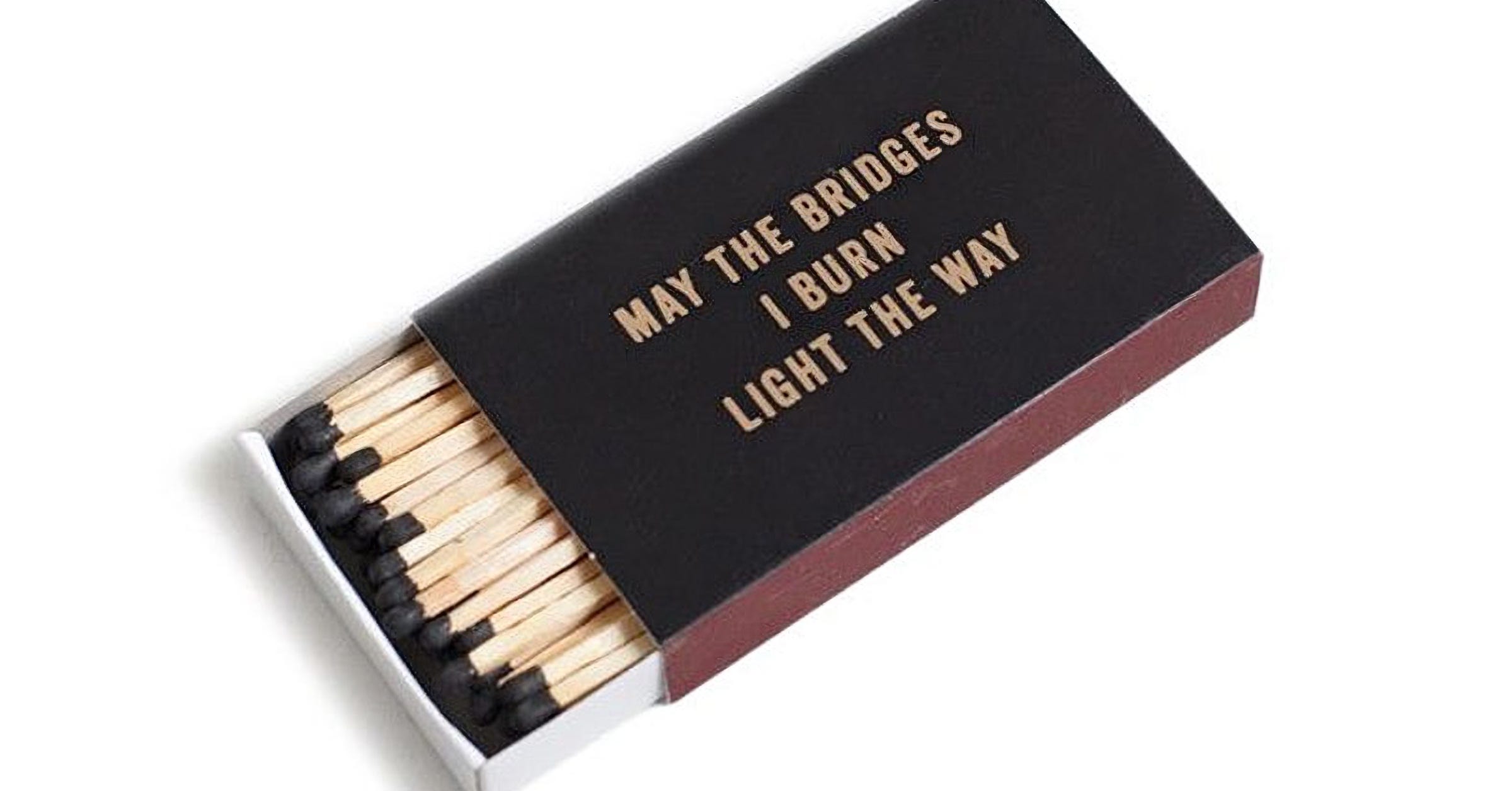
May the Bridges I Burn Light the Way
Nothing you have built disappears when you decide to move on from it. The degree, the career, the relationship, the version of yourself that started all of it, none of it gets erased. It becomes the ground you learned on, the thing that informs the next thing, the better thing, the thing you couldn’t have reached without having been wrong first.
Change is not the opposite of commitment. It is, in most cases, the fullest expression of it.
The sunk cost fallacy was never really about the cost. It was always about the story and you are always allowed to write a new one.
Written by Mark